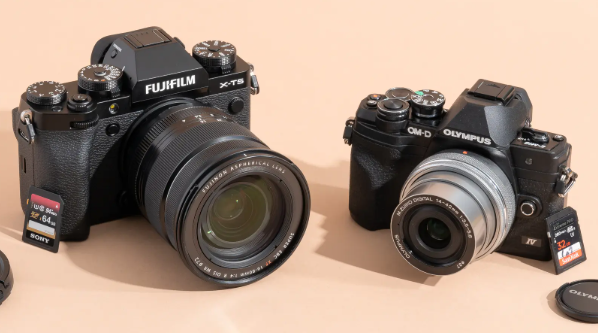
Unlike DSLR cameras, which incorporate a mirror system to either bounce incoming light into an optical viewfinder or send it directly to the image sensor, mirrorless cameras completely eliminate the mirror assembly. This means that any light entering the lens always travels straight to the sensor without any redirection. As a result, mirrorless systems forgo the traditional optical viewfinder (OVF), opting instead for digital solutions such as electronic viewfinders (EVFs) and LCD displays that digitally render the image as captured by the sensor. The absence of mirrors and prisms makes mirrorless designs inherently simpler, more compact, and lighter than their DSLR counterparts.
Here’s a visual comparison that outlines how a DSLR differs from a mirrorless camera:
Clearly, DSLRs contain a significantly more complex internal structure than mirrorless models. This includes a range of additional components like a reflex mirror, a focusing screen, a condenser lens, and either a pentaprism or pentamirror. Also found within DSLRs are elements like a secondary mirror and a phase-detection autofocus module, which contribute to the camera’s bulk and mechanical complexity.
How Mirrorless Cameras Function
Mirrorless cameras adopt a more streamlined approach to image capture. Light enters through the lens (#1) and hits the image sensor (#4) directly, bypassing any mechanical redirection. The traditional optical viewfinder is replaced by an electronic viewfinder (#9), which digitally mimics the scene captured by the sensor. The mechanical shutter (#3) usually remains open during regular use and typically only closes at the end of an exposure. Because these systems lack both mirrors and optical prisms, the distance between the lens mount and the sensor—known as the flange distance—can be significantly reduced. This enables mirrorless bodies to be more slender and lightweight than traditional DSLRs, as illustrated above.
Mirrorless cameras offer several notable advantages over DSLRs. Beyond their reduced size and weight, the electronic viewfinder provides real-time previews that reflect actual camera settings—such as white balance, contrast, and saturation—directly through the viewfinder. Photographers can also benefit from overlays like live histograms and exposure warnings, giving them a precise view of the final image. Furthermore, features such as focus magnification, focus peaking, and face detection—enabled by contrast or on-sensor phase detection—help ensure highly accurate focusing. In bright outdoor conditions, the EVF serves as a useful alternative to the rear LCD for reviewing photos.
However, mirrorless systems are not without their shortcomings. First, since the EVF requires constant power and sensor activation, it can lead to faster battery depletion. Second, EVFs may introduce latency, blackouts, or exaggerated contrast, which might be distracting or uncomfortable for some users. While autofocus capabilities in modern mirrorless cameras have improved dramatically, they may still fall short in tracking fast-moving subjects under dim lighting conditions when compared to high-end DSLRs.
